
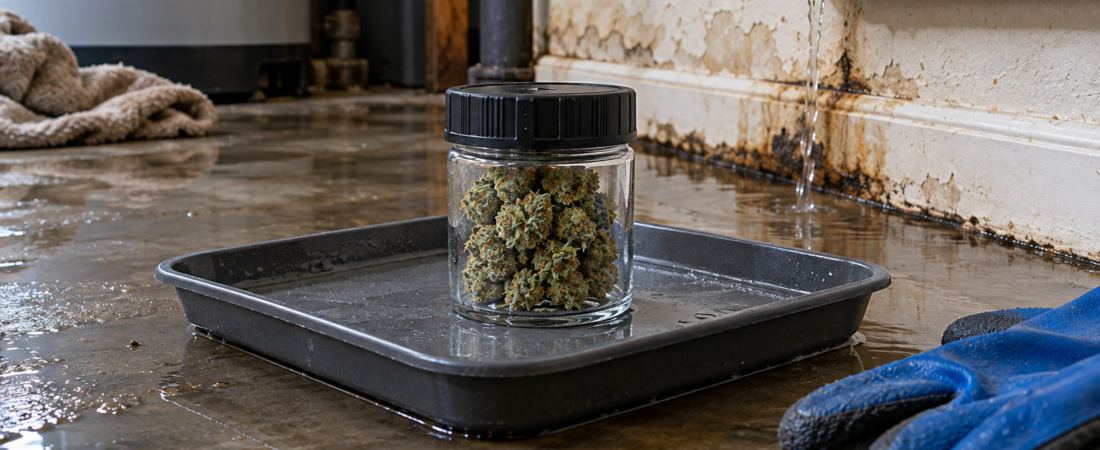
A basement leak, burst pipe, sewer backup, or community flood can leave cannabis packages wet, dirty, or mixed into damaged household storage. The safest response is not to judge a product by smell or appearance alone. Floodwater can contain sewage, fuel, chemicals, and other contaminants, while even clean-looking water can damage labels, seals, cartons, batteries, and child-resistant packaging.
This guide gives Canadian adults a practical way to isolate affected products, preserve useful evidence, and decide who to contact. It does not replace emergency instructions, product-specific advice from a licence holder, or municipal directions for hazardous waste and battery disposal.
People and the building come first
Do not enter a flooded area until local authorities or a qualified professional say it is safe. Water can hide electrical hazards, unstable materials, sharp objects, sewage, mould, and chemical contamination. Health Canada’s flood cleanup guidance recommends dealing quickly with standing water and water-damaged materials while using appropriate protection.
Cannabis is a secondary concern during an active emergency. Account for people, pets, medication, power, safe drinking water, and building hazards first. If a package sits near a damaged outlet, appliance, battery, fuel container, or contaminated water, leave it until the area can be approached safely.
Do not use a product that contacted floodwater
Floodwater contact should be treated as a contamination concern, even when the outer package looks closed. Do not open the product to “check” it, taste an edible, inhale from a cartridge, or rinse a package and assume the contents are safe. Water can enter around seams, closures, labels, charging ports, and small defects that are difficult to see.
Health Canada advises discarding food products that may have contacted floodwater and checking stored goods for damaged containers. Cannabis is not ordinary food, but the same underlying warning matters: a wet exterior does not prove the contents are protected. Keep the item isolated and ask the licence holder or legal retailer for product-specific instructions.
Use a three-zone sorting method
| What happened | Immediate step | What not to do |
|---|---|---|
| Direct floodwater or sewage contact | Isolate the sealed item, avoid handling it unnecessarily, and follow local cleanup and disposal directions. | Do not open, rinse, dry for reuse, or return it to normal storage. |
| Clean-water leak reached the package | Keep it closed, photograph the damage, and contact the producer or legal retailer for guidance. | Do not assume the seal, label, edible, cartridge, or battery is unaffected. |
| Stored nearby but remained dry | Move it only when the area is safe; inspect the package, label, seal, and storage conditions. | Do not combine it with wet items or remove it from the original package. |
Use separate containers or bags for clearly dry items and potentially contaminated items, but do not create a new unlabelled cannabis package. Keep the original container intact so the product name, lot number, package date, warnings, and producer contact details remain available.
Photograph before labels disappear
Water can lift ink, dissolve adhesive, and make a lot number unreadable. From a safe position, photograph the front and back of the package, lot number, package date, product size, seal, damaged area, and any water line or residue. Save the receipt or order record if it is still available.
Those details help a retailer or licence holder identify the item without relying on a strain name or package colour. Our Canadian cannabis recall guide explains why exact lot and package identifiers matter when checking an official notice.
Different formats create different cleanup risks
- Dried flower and pre-rolls: paper, cardboard, seals, and plant material can absorb moisture. Do not try to air-dry a flood-exposed product for later use.
- Edibles and beverages: keep them away from ordinary food cleanup so nobody mistakes a damaged cannabis product for a snack or drink.
- Oils and concentrates: leakage, a loose cap, a wet label, or residue around the container is enough reason to isolate the item and seek instructions.
- Vape cartridges and batteries: water exposure can damage electronics and lithium-ion cells. Do not charge, test, heat, puncture, or place a wet device in regular recycling.
- Topicals: a wet carton or jar can lose instructions and traceability information even when the formula itself is not visibly exposed.
For batteries, cartridges, and packaging, use the safer routing principles in our cannabis packaging and vape disposal guide. Local programs differ, and a flood-damaged battery may require specific hazardous-waste handling.
Avoid the common “save it” mistakes
Do not use a hair dryer, oven, microwave, heater, direct sunlight, or open flame to dry a cannabis product or vape device. Heat can damage packaging, change the product, and create a battery or fire hazard. Do not wipe off a package and put it back beside dry products. Do not transfer contents into a clean jar, because that removes the original label and can move contamination to the new container.
Visible mould is not the only concern after water damage. Bacteria and chemicals may not produce an obvious smell or colour. The inspection steps in our cannabis mould and shelf-life guide are useful for ordinary storage questions, but they cannot certify a flood-exposed product as safe.
Keep children, pets, and cleanup helpers away
Flood cleanup often moves belongings into hallways, garages, bins, vehicles, or temporary accommodation. That disruption can place cannabis where children, pets, visitors, or contractors can reach it. Put isolated products in a clearly controlled area that remains inaccessible to others, without opening or repackaging them.
Do not leave edibles loose in a general food-disposal pile. Do not place cartridges or batteries where someone may test them. If accidental exposure may have occurred, call 911 for an emergency or contact the appropriate poison centre or veterinarian. Our home cannabis safety guide has additional prevention steps.
Who to contact and what to ask
Start with the producer contact information on the original package when it remains readable. Give the product name, lot number, package date, format, and a factual description of the water exposure. Ask whether the product should be returned, isolated for investigation, or disposed of under local rules.
A legal retailer may explain its damaged-product process, but do not bring a wet or contaminated item into a store without asking first. For community disposal rules, contact the municipal waste program and explain that the item may include cannabis, contaminated packaging, a cartridge, or a lithium-ion battery. If the problem appears connected to manufacturing rather than the flood, check the federal Recalls and Safety Alerts database.
A five-minute recovery checklist
- Wait until the area is safe to enter.
- Separate direct-contact, possibly exposed, and clearly dry products.
- Do not open, use, charge, rinse, heat, or repackage affected items.
- Photograph the package, lot number, date, seal, and damage.
- Keep cannabis away from food cleanup, children, pets, and visitors.
- Contact the producer, legal retailer, and local waste program as appropriate.
- Follow special instructions for cartridges and lithium-ion batteries.
- After cleanup, store unaffected products in one cool, dry, secure location.
Bottom line
Water damage is not a situation for guesswork. Protect people first, isolate affected cannabis without opening it, preserve the identifying details, and use official or product-specific advice for the next step. A product that looks dry after cleanup can still have a damaged seal, unreadable label, contaminated exterior, or unsafe battery. When the exposure is uncertain, pause use rather than trying to rescue it.