
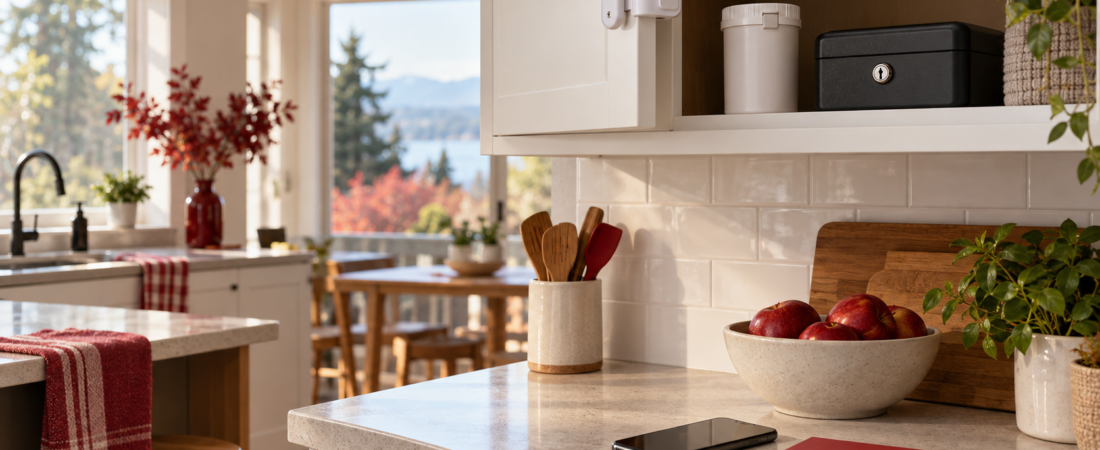
Cannabis can be legal for adults and still be dangerous when a child reaches it. Edibles are the clearest household risk because a gummy, chocolate, cookie, or drink can look like ordinary food. Oils, capsules, dried flower, vape cartridges, and discarded packaging also deserve secure storage. A young child does not need to understand a label to open a drawer, climb onto a chair, or copy what an adult does.
The safest system has several layers: keep cannabis in its original child-resistant package, place that package inside a locked container, store the container out of sight and reach, and make sure every adult or visitor follows the same routine. If exposure may already have happened, skip blame and act quickly. The product label, the estimated amount, and the time of exposure can help a poison specialist or medical team give better advice.
- Move the product away and prevent any further exposure.
- Call 1-844-POISON-X for poison-centre guidance; in Quebec, call 1-800-463-5060.
- Call 9-1-1 if the child loses consciousness, has difficulty breathing, or has another severe or rapidly worsening symptom.
- Keep the package or take clear photos of the label. Be ready to describe the product, THC amount, possible quantity, time, symptoms, age, and weight.
Why accidental exposure can be hard to spot
Children may not say what they ate, and an edible can be missing before an adult notices. Symptoms can also resemble fatigue, illness, a missed nap, or another medication exposure. Health Canada lists signs such as sleepiness, lack of coordination, unusual quietness, slurred speech, weakness, and difficulty breathing. A child can become very ill after consuming cannabis, so uncertainty is a reason to call for professional guidance rather than wait for proof.
Do not try to make the child vomit or give a home remedy unless a poison specialist or healthcare professional specifically directs you to do so. Do not delay a call because you are embarrassed or worried about judgment. Accurate information is a safety tool. Tell the responder that cannabis may be involved and mention any other ingredients, especially if the product was a chocolate, baked item, beverage, concentrate, or an unregulated product with uncertain strength.
Use a two-lock storage plan
A child-resistant package is useful, but it is not childproof. Packaging can be left partly open, damaged, transferred to another container, or defeated by a persistent child. Treat the original package as the first barrier and a locked box, cabinet, or drawer as the second.
Choose a storage point that children cannot see during ordinary routines. A high unlocked cupboard is weaker than it looks: chairs, counters, and pantry shelves become climbing routes. A bedside table, handbag, coat pocket, vehicle console, and refrigerator door are also unreliable because they are familiar places that children explore.
| Risk point | Weak setup | Safer routine |
|---|---|---|
| Daily storage | Original package on a high shelf | Closed original package inside a locked, out-of-sight container |
| Edibles | Beside ordinary snacks or in a shared food bin | Separate locked storage with the legal label intact |
| After use | Product or wrapper left on a table | Immediate count, closure, lockup, and surface check |
| Visitors | Cannabis kept in a purse or luggage | Offer the same locked storage used by the household |
Store the key or combination separately and do not reveal the code during play or household routines. Adults should still be able to reach the container quickly enough to check the package during an emergency call. Our guide to storing cannabis at home in Canada covers light, heat, moisture, odour, and household access in more detail.
Keep legal packaging and labels intact
Transferring edibles into a candy jar, zipper bag, vitamin organizer, or unmarked food container removes important warnings and makes a mix-up more likely. Keep each product in the original package with the product name, THC and CBD information, lot details, and warnings readable. If the outer packaging and immediate container carry different useful details, keep them together.
Do not place cannabis gummies beside ordinary gummies, cannabis beverages beside soft drinks, or cannabis chocolate beside family snacks. The safest visual cue is separation: one locked location for cannabis, another location for regular food. If several adults use different products, avoid combining them in a way that makes the original label impossible to match to the remaining product.
Our guide to reading a Canadian cannabis product label explains THC units, CBD information, packaging dates, lot numbers, standardized symbols, and required warnings. Knowing where those details appear makes it easier to report accurate information during a poison-centre call.
Create an after-use reset
Many storage failures happen during the few minutes after use rather than during long-term storage. An adult may set down an open container, leave part of an edible on a plate, forget a vape in a couch cushion, or discard a wrapper that still has residue. Build a short reset into every use:
- Count or visually check what remains.
- Close the original package completely.
- Return it to locked storage before doing something else.
- Check the table, floor, couch, counter, and waste area.
- Wash hands and any surface that contacted oil, concentrate, or edible residue.
Used cartridges, empty packages, food wrappers, and homemade edible scraps should remain inaccessible until they are disposed of. Do not leave waste in an open kitchen or bathroom bin. Municipal waste and recycling rules vary, so follow local instructions while keeping all cannabis-related waste secured from children and pets until collection.
Include guests, babysitters, and older children in the plan
A household system fails if it applies only to the person who bought the product. Ask adult visitors to hand over cannabis for locked storage rather than leaving it in a purse, backpack, coat, or suitcase. Before a babysitter arrives, verify that every product is locked away and explain where emergency information is kept without sharing the storage code unless that access is genuinely required.
Older children and teenagers also benefit from direct, age-appropriate expectations: cannabis products are for adults, labels must not be removed, and finding a product is a reason to tell an adult rather than touch or taste it. Avoid turning the storage location into a secret challenge. The physical lock should carry the security burden.
If children move between homes, coordinate storage standards with grandparents, co-parents, and other caregivers. A weekend bag can carry the same risk as a kitchen drawer. Check bags before they enter a play area and never assume another adult’s “high shelf” is equivalent to locked storage.
Prepare an exposure information card
Put the poison-centre number in each caregiver’s phone and post it where adults can find it quickly. A short household card can list the child’s age and approximate weight, allergies, medications, healthcare number location, and the address where emergency responders should go. Keep the card free of passwords or unnecessary personal details.
If exposure happens, bring the product package to the phone. Note the likely time, maximum possible amount, and symptoms you have seen. Do not guess with false confidence; a range is more useful than an invented exact amount. If the product is homemade or from an unregulated source, say so clearly because the actual ingredients and potency may be uncertain.
Reduce edible confusion before it starts
Edibles deserve extra care because their appearance and smell can overlap with familiar treats. Serve ordinary snacks separately, clean the preparation area, and return cannabis products to locked storage immediately. Never ask a child to fetch a cannabis package or use an ordinary candy container as temporary storage.
If an adult has taken an edible, impairment can make supervision and emergency decisions harder. Arrange for a sober, unimpaired adult to remain responsible for children. Our Ontario edibles storage guide has more practical steps for keeping gummies and chocolates separated, labelled, and protected from heat and household access.
Use official guidance when the situation is uncertain
Health Canada’s cannabis poisonings in children guidance lists possible symptoms, prevention steps, poison-centre contacts, and the situations that require 9-1-1. Its prevention brochure also emphasizes child-resistant packaging, locked storage, and keeping cannabis separate from regular food.
Public-health instructions can change, and a poison specialist can tailor advice to the product and child. Keep the current official page bookmarked rather than relying on a screenshot or a social-media post during an emergency.
Bottom line
Preventing accidental cannabis exposure is less about finding one perfect container and more about using the same safe routine every time. Keep the original package closed, add a real lock, store it out of sight, reset the area after use, and include visitors and caregivers in the plan.
If a child may have consumed cannabis, call the poison centre promptly and call 9-1-1 for loss of consciousness, breathing difficulty, or another severe emergency. Fast, honest information is more useful than waiting to see whether symptoms disappear.