
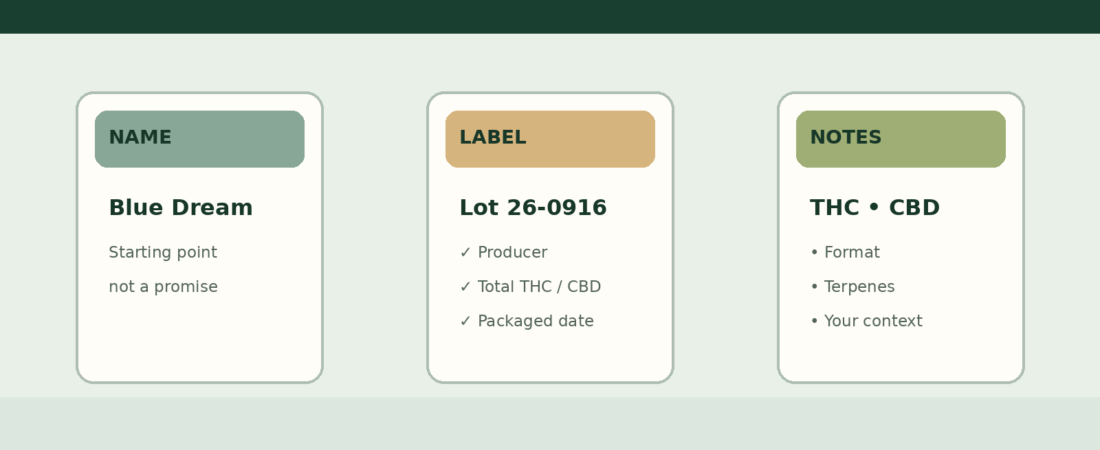
A familiar cannabis strain name can make a shelf feel easier to navigate. Names such as Blue Dream, OG Kush, Gelato, or Northern Lights create expectations about aroma, strength, and the kind of experience a product may offer. The problem is that the name is only one clue. It is not a guarantee that two packages from different producers—or even two lots from the same product line—will be identical.
Canadian shoppers can make a more useful comparison by treating the strain name as a starting point, then checking the regulated package for the product class, total THC and CBD, lot number, packaging date, ingredients when required, and producer contact information. If terpene information is supplied, it can add context, but it should not be treated as a promise of a specific effect.
- Confirm that the product comes from a legal source.
- Match the exact product format and package size.
- Read total THC and CBD from the current package.
- Record the producer, lot number, and packaging date.
- Use the strain name and terpene list as context—not a guaranteed outcome.
Why the same name can describe different cannabis
Cannabis names developed through breeding, regional use, brand storytelling, and informal market convention. There is no universal retail rule that makes every product sharing a name chemically identical. Growing conditions, plant selection, harvest timing, curing, storage, and processing can all affect the finished product.
Research supports a cautious approach. A peer-reviewed study on cannabis labelling and genetic variation found that broad sativa–indica labels did not reliably reflect genetic relatedness, and samples with the same cultivar name could be genetically and chemically distant. That does not make every name meaningless. It means the name should not replace the current package details.
The practical takeaway is simple: compare the product in your hand, not a memory of a name you bought months ago. A strain review can help you build questions, but it cannot tell you the exact composition of every future lot sold under that name.
Start with the regulated package
Health Canada explains that a legal cannabis package carries standardized information intended to help consumers reduce harm. Its guide to reading a cannabis product label identifies total THC and CBD, the product class, net amount, storage directions, lot number, packaging date, and producer contact details among the important fields.
Notably, a strain name is optional information. That is a useful reminder about priority: the name may help distinguish products, while the required package information helps you identify and compare the actual regulated item.
| Signal | What it can tell you | What it cannot promise |
|---|---|---|
| Strain or cultivar name | A product identity and a starting point for research | Identical chemistry or effects across producers and lots |
| Sativa, indica, or hybrid | How a producer or retailer groups the product | A predictable experience for every person |
| Total THC and CBD | The labelled cannabinoid amount or concentration | A complete forecast of intensity, comfort, or duration |
| Terpene list | Additional aroma-related product information when supplied | A medical benefit or guaranteed mood |
| Lot and packaging date | Which production lot you have and when it was packaged | Perfect storage after the package left the producer |
Do not use sativa and indica as effect guarantees
Many menus still organize flower into sativa, indica, and hybrid sections. Those categories may be convenient for browsing, but they are too broad to function as dosage instructions or promises about how you will feel. People vary in tolerance, experience, health, medications, setting, sleep, food intake, and sensitivity. Product format and amount also matter.
Instead of asking only, “Is it indica or sativa?”, ask: What is the product class? What does the current package say about total THC and CBD? Is this a new lot? How much do I intend to use? Do I need to drive, work, supervise children, or complete another safety-sensitive task?
If you are new to cannabis, the WeedMarkers first-time cannabis checklist covers planning, timing, and reasons to pause. No retail category should override a conservative amount or a sober transportation plan.
Read THC and CBD carefully, but do not shop by one number
Total THC and CBD provide regulated cannabinoid information, and they deserve more weight than a dramatic product name. Still, the highest THC number is not automatically the best fit or best value. A stronger product can be harder to use predictably, especially for someone with low tolerance or limited experience.
Compare like with like. Dried flower may show a concentration such as milligrams per gram, while edibles may show the amount per unit and per package. Extracts and oils can use other presentations. Our Canadian cannabis label guide walks through those units and the difference between the amount as packaged and total cannabinoid content.
When two products share a name, write down the producer, total THC, total CBD, package size, lot number, and packaging date. That small record is more useful than assuming the name alone will recreate a past purchase.
Use terpene information as descriptive context
Terpenes are aromatic compounds found in cannabis and many other plants. A package or retailer may list compounds such as myrcene, limonene, pinene, caryophyllene, or linalool. This can help describe why one lot smells citrusy, peppery, pine-like, floral, or earthy.
However, a terpene list is not a prescription. Avoid turning one listed compound into a guaranteed health, sleep, anxiety, or energy claim. The information may be incomplete, reporting methods can differ, and individual response varies. Use aroma information to compare products you already consider suitable—not to ignore potency, medications, pregnancy, mental-health risk, or another reason to avoid cannabis.
Compare the producer and the lot, not just the strain
A better shopping note looks like this: “Producer A, product name, dried flower, 3.5 g, current total THC and CBD, packaged on this date, lot number, aroma notes.” That gives you something concrete to compare on a later visit.
If a product seems unusually dry, damaged, incorrectly labelled, or different from what the package describes, keep the package and receipt. Health Canada says the producer contact information can be used for questions about quality issues or unwanted effects, and the lot number and packaging date help identify the product.
For flower-specific checks, use the WeedMarkers guide to choosing dried flower in Ontario. It covers freshness, packaging, potency, storage, and reasons to leave a product on the shelf.
Use reviews and directories without treating them as laboratory reports
Reviews, strain databases, and retailer directories can be useful for vocabulary and discovery. They can show how a name is commonly described, which formats are listed, and what questions other shoppers ask. They should not replace the exact package or official legal-source check.
For example, CannaRadar can serve as one cannabis-listing research layer while you compare how products and retailers are presented. Before paying, confirm the seller through the appropriate provincial or territorial source and verify the current product details at the retailer. A directory listing is not proof that a particular lot will match a past review.
Likewise, use the WeedMarkers OG Kush review or another strain profile to learn common terminology, then return to the current package. The review is a guide to the name, not a substitute for the regulated item in front of you.
A practical way to compare two products with the same name
- Verify the source: confirm both products are offered through legal channels.
- Match the format: compare flower with flower, not flower with a vape or edible.
- Record the package: producer, product name, net amount, total THC, total CBD, lot, and packaging date.
- Check optional details: note terpenes, aroma descriptions, and cultivation claims only after the required information.
- Choose for your actual use: consider experience, planned amount, setting, storage, and safety-sensitive responsibilities.
- the seller cannot be verified through an official source;
- the listing and package disagree about format or potency;
- the package is damaged or the regulated information is unreadable;
- you are choosing only because the THC number is higher;
- a review makes a guaranteed health claim; or
- you expect the name alone to reproduce a previous experience.
Bottom line
A cannabis strain name is useful shorthand, not a chemical fingerprint. Use it to begin your research, then let the current package carry the comparison: legal source, product class, producer, total THC and CBD, net amount, lot number, packaging date, and storage directions.
The most dependable purchase is not the one with the most famous name. It is the one you can identify clearly, compare honestly, use conservatively, and trace back to a regulated package if something is wrong.