

Cannabis can be legal for adults and still be incompatible with a particular shift, task, workplace policy, or commute. The useful question is not whether cannabis is legal in the abstract; it is whether you can arrive, work, communicate, and get home safely without impairment or uncertainty.
That matters especially in jobs involving driving, machinery, heights, public safety, patient care, food preparation, or decisions that affect other people. It also matters in office and remote work, where slowed thinking, missed handoffs, poor judgment, or a video call can create real consequences. A simple plan before the workday is more reliable than trying to judge your readiness in the moment.
- Read your employer’s current fitness-for-duty, safety, and reporting rules.
- Ask whether today includes driving, equipment, heights, client care, or another safety-sensitive task.
- Plan cannabis use so you are not impaired at work or during the commute.
- Choose a sober ride home if you used cannabis and could still be affected.
- If you are unsure whether you are fit for duty, pause and use the reporting route in your workplace policy.
Legal access is not the same as fitness for duty
Canadian law allows adults to access cannabis within federal, provincial, and territorial rules. Employers still have duties to maintain a safe workplace, and workers have duties to work safely. A workplace policy may set expectations about impairment, reporting, possession, smoking or vaping areas, medication disclosure, testing where lawfully used, and the process for safety-sensitive work.
Policies differ by employer, union agreement, province, role, and industry. Do not rely on a coworker’s interpretation or a policy you read years ago. Find the current written version, read the definitions of “fit for duty” and “safety-sensitive,” and ask HR, a supervisor, a union representative, or a safety contact to explain the reporting process if it is unclear.
For a grounding in day-to-day impairment planning, our guide to cannabis and driving in Canada explains why a person should not use a subjective feeling of “fine” as proof they are ready to drive.
Impairment does not look the same in every task
Cannabis can affect attention, reaction time, coordination, judgment, and short-term memory. Those effects have different consequences in different jobs. A forklift operator, nurse, dispatcher, delivery driver, lab worker, cashier, software reviewer, and remote manager do not face the same risks, but each may need sustained attention and sound judgment.
| Today’s task | Why impairment matters | Practical planning step |
|---|---|---|
| Driving or mobile equipment | Reaction time and hazard recognition affect others as well as you | Arrange a sober commute and follow the employer’s fitness-for-duty process |
| Machinery, tools, heights, or hot surfaces | Small timing or coordination errors can cause injury | Do not start the task while impaired or uncertain; report as required |
| Care, service, or public-facing work | Communication, records, privacy, and decisions can be affected | Use the workplace escalation route before a shift or appointment |
| Remote or desk work | Errors, missed details, and video meetings still carry professional consequences | Treat the workday and work calls as work, not as an exception to the policy |
Do not compare your readiness with someone else’s. Product format, THC and CBD amounts, frequency of use, sleep, food, other substances, medications, and personal response can all change how cannabis affects a person. A legal product label can help you understand what was used, but it cannot certify that you are ready for work. Our guide to reading a Canadian cannabis product label can help you record the product accurately if a health or workplace conversation requires details.
Plan the whole shift, including the commute
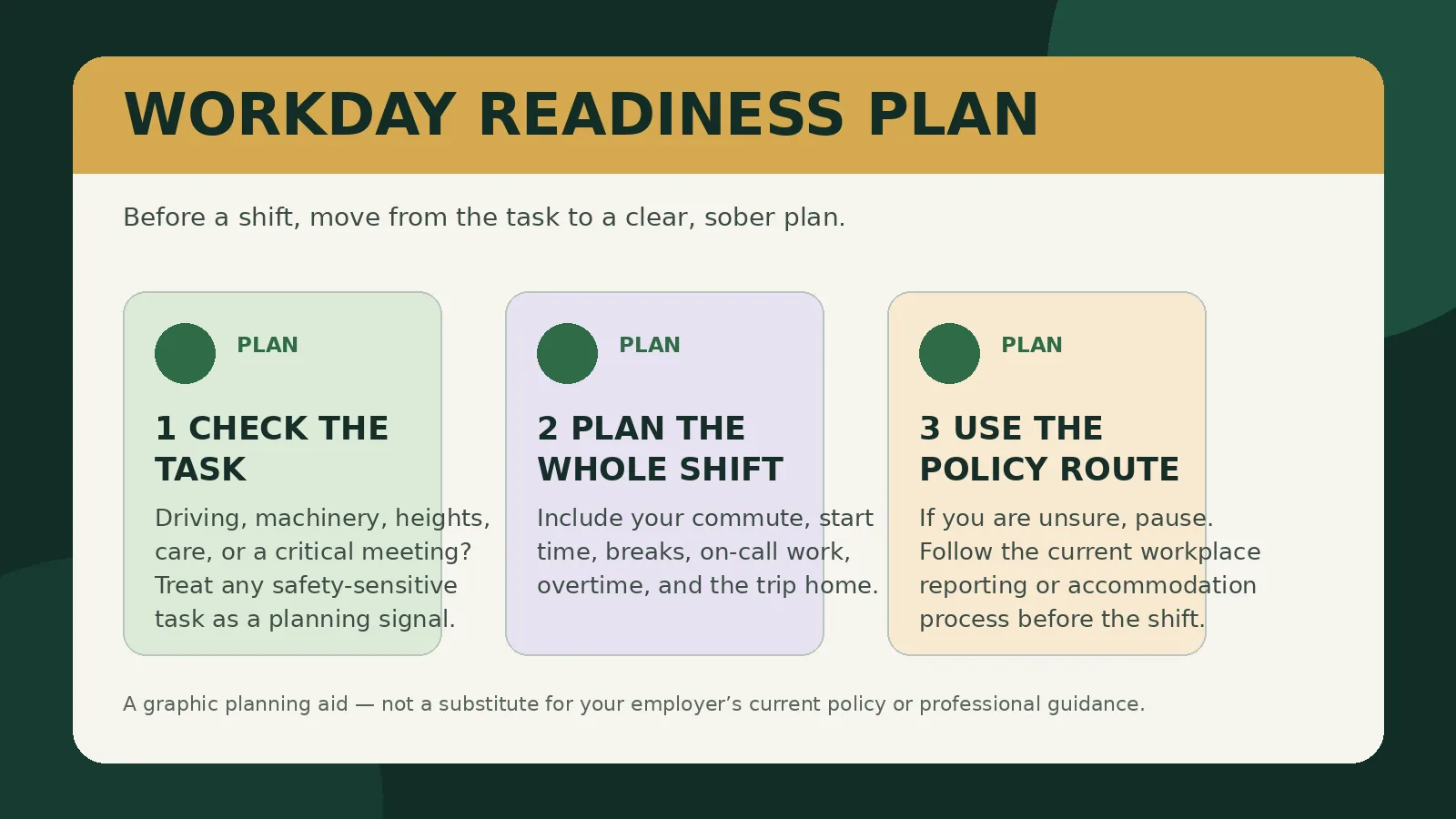
Workplace planning starts before clock-in and ends after you get home. Think through the complete sequence: your travel, the start time, breaks, any on-call responsibilities, overtime possibility, and the trip home. If cannabis use could overlap with any safety-sensitive part of that sequence, make a different plan.
Edibles can be particularly easy to misjudge because effects may begin later and last longer than a person expects. Smoking or vaping can feel more immediate, but that does not make the next work task or drive safe. Avoid using cannabis to solve fatigue before a shift; fatigue and impairment can compound one another. Rest, food, hydration, a schedule adjustment, or speaking with a health professional are safer responses to a recurring sleep or stress problem.
If you use cannabis for a medical reason, do not make an abrupt change based on an online article. Discuss the work implications with the clinician who knows your health history, and ask your employer or union about the accommodation process that applies to your role. The goal is a practical, confidential plan—not self-diagnosis or a last-minute disclosure at a worksite.
- Driving or operating a bike, scooter, or vehicle? Keep the whole trip sober; do not treat a short route as an exception.
- Still uncertain about effects, timing, or readiness? Do not start a safety-sensitive task or commute alone—use a sober ride, delay the trip, or follow the workplace reporting process.
- Shift running late or plans changing? Recheck the ride home before overtime, an on-call task, or a new assignment changes the plan.
- Using cannabis for a medical reason? Ask the appropriate clinician and workplace accommodation contact for a plan before the shift, rather than improvising at the worksite.
Know what to do when you are unsure
Uncertainty is a reason to stop and use the process, not a reason to push through. Workers should know who to contact before a shift and what information is needed. Employers should make that path clear, respectful, and focused on safety. A good conversation does not require personal detail beyond what the workplace process or accommodation discussion genuinely needs.
Do not attempt to hide impairment, drive to work anyway, take on a risky task to “prove” you are okay, or ask a coworker to cover a safety-critical step informally. If a supervisor raises a concern, respond calmly and follow the established procedure. If you think a policy is unclear or inconsistently applied, document the question and ask for clarification through the appropriate channel.
Use clear language in a workplace conversation
A short, practical question is usually better than a long explanation. You might ask: “I want to make sure I understand our fitness-for-duty process for this role. Who should I contact if I am not fit to perform a safety-sensitive task?” If cannabis is medically authorized or connected to a health issue, ask about the accommodation contact rather than sharing unnecessary medical details with coworkers.
For new or returning users, our first-time cannabis safer-use checklist offers a conservative approach to pacing and avoiding situations where impairment could create a problem. The workplace remains a separate setting: follow your employer’s current rules even when off-duty use is legal.
Keep the policy and official guidance close
The Canadian Centre for Occupational Health and Safety explains that workplace impairment can have many causes and that workplaces need clear, fair procedures focused on safety. Health Canada’s lower-risk cannabis guidance also advises avoiding driving and operating machinery after cannabis use. These sources are useful for understanding the safety context, but your employer’s current policy and any applicable collective agreement set the day-to-day process for your position.
Read CCOHS guidance on workplace impairment and Health Canada’s Lower-Risk Cannabis Use Guidelines alongside your workplace policy. If you have questions about a regulated role, a medical accommodation, or a specific safety rule, get advice from the responsible workplace or professional contact before the shift begins.
Bottom line
A reliable workday plan does not depend on guessing whether you look or feel impaired. It uses the actual task, the employer’s policy, a sober commute, and an early reporting path when something is uncertain. Cannabis can be legal off duty while still being incompatible with a particular shift or responsibility.
Read the policy, plan ahead, avoid driving or safety-sensitive work after cannabis use, and speak up early when you need guidance. That protects you, your coworkers, and the people who depend on your work.