
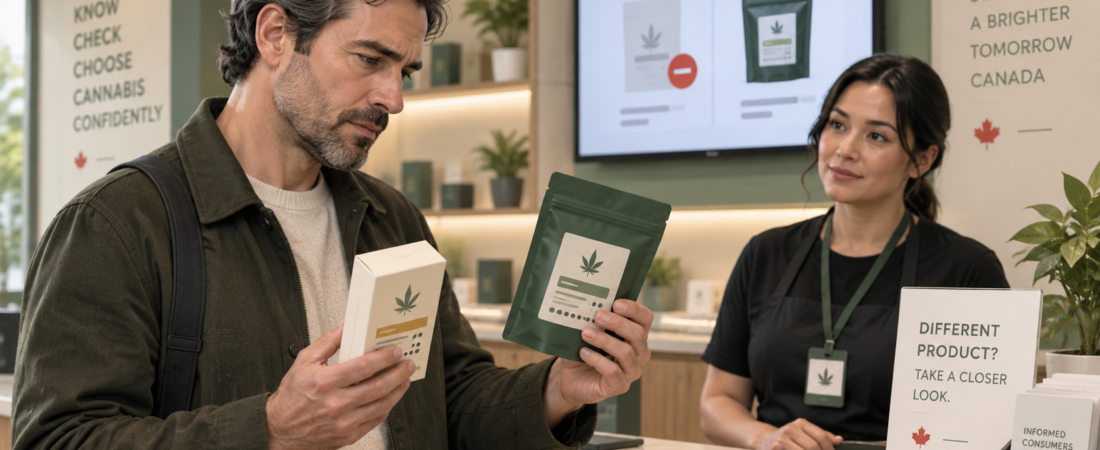
A cannabis product can disappear from an online menu between research and checkout. A store may suggest another package with a similar name, format, or THC range, but “similar” does not mean identical. The replacement can come from a different producer, lot, size, formulation, or package date, and those differences can change dose planning, freshness, price per unit, and how well the product fits your original purpose.
Treat every substitution as a new buying decision. Pause, identify what changed, read the replacement package on its own terms, and decide whether it still meets your limit. That is safer than accepting the closest-looking option because a menu card, courier message, or store employee describes it as equivalent.
- Confirm the exact product name, producer, format, and package size.
- Recalculate the amount of THC and CBD per unit or serving.
- Check the package date, lot number, ingredients, and warnings.
- Compare the final price, not just the shelf price.
- Decline the replacement if any important detail is missing or outside your plan.
Why a replacement deserves a fresh review
Two products can occupy the same menu category without working the same way. A 10-pack of gummies and a 2-pack can contain the same total THC but divide it into very different portions. Two oils may use different carrier oils, dropper markings, or concentrations. Two dried-flower packages may share a strain name while differing in producer, lot, package date, terpene profile, and moisture condition.
Even a replacement from the same brand can be a different lot or package size. Do not rely on a screenshot, a previous order, or a remembered label. Use the information attached to the package you would actually receive. Our Canadian cannabis label guide explains how to find total THC, total CBD, net quantity, ingredients, package details, and the lot number.
Identify what problem the original product was solving
Before comparing alternatives, write down why you chose the original. Was the priority a low amount per piece, a non-inhaled format, a smaller package, a specific ingredient restriction, a recent package date, or a firm budget ceiling? If the original choice was simply “the highest THC for the price,” step back. Potency alone is not a quality score, and a stronger replacement can make portioning harder rather than improving value.
Use one or two non-negotiables and a few preferences. For example, a buyer might require no more than 2.5 mg THC per serving and a clearly marked package, while treating flavour and brand as preferences. That makes the decision easier when stock changes because the replacement either passes the essential checks or it does not.
| What changed? | Recheck | Reason to pause |
|---|---|---|
| Package size | Total amount, units, and storage plan | More product than you intended to keep at home |
| THC or CBD | Amount per unit and total package | The portion no longer matches your plan |
| Producer or lot | Label, package date, ingredients, and lot number | The listing reuses old photos or incomplete details |
| Price | Final total and price per unit | A larger package only looks cheaper |
Recalculate dose and portion size from zero
Do not carry the original dose assumption into a different product. Read both the amount per unit and the total amount in the package. A package can present several numbers, and the largest number on a menu card may not be the number that matters for one serving.
For an edible or capsule, ask how much THC and CBD is in one piece and how many pieces are in the package. For an oil, confirm the concentration and the volume represented by the dropper marking you plan to use. For dried flower, pre-rolls, or concentrates, do not turn a percentage into a precise effect forecast. Product format, personal tolerance, inhalation pattern, and context all matter.
If the replacement is stronger or harder to divide accurately, declining it can be the most practical choice. The comparison framework in our guide to THC percentage and cannabis quality can help keep potency in perspective.
Check the package details, not only the menu card
Online listings are useful for shortlisting, but they may use representative photos or rounded potency ranges. Current stock can belong to a different lot than the image. Before paying or accepting a handoff, compare the physical package with the order: exact product, producer, format, size, THC and CBD information, lot number, and package date.
Health Canada explains that standardized cannabis packaging includes required product information and health warnings. Its guidance on reading and understanding a cannabis product label is the right reference for what legal packages communicate. If a seller cannot show enough information to identify the proposed replacement, do not guess.
Never accept an opened, unlabelled, or privately repackaged item as a substitute for a regulated product. Keep the original package after purchase so the lot and product details remain available if there is a recall, adverse reaction, or quality concern.
Compare discovery tools with official verification
A directory or comparison site can help you see how products and retailers are presented across different menus. For example, CannaRadar can be used as a discovery layer when you are looking for alternative listings after an item disappears. It should not replace the current product label, the seller’s live checkout information, or the official provincial or territorial source used to verify legal retailers.
Canada’s provincial and territorial cannabis rules page links to the authorities responsible for each market. Use the relevant official source to confirm where legal cannabis can be purchased, then verify the exact store or website before entering payment details. The step-by-step checks in our Ontario legal-store and delivery verification guide show how to separate discovery from authorization.
Recheck the final cost and amount you are bringing home
A substitution can increase both spending and household risk. A larger package may reduce the price per gram or per piece while raising the total bill and leaving more cannabis to store. Delivery fees, minimum orders, taxes, and add-on purchases can also change the final cost.
Compare the landed total and the amount you originally planned to buy. Do not add unrelated products just to reach a minimum. If a replacement exceeds your budget or storage plan, ask whether a smaller package is available, choose pickup if that meaningfully reduces cost, or wait for suitable stock. Our cannabis shopping budget guide offers a simple value comparison that does not reward overbuying.
Use a clear approval rule for deliveries and pickups
If a store contacts you about a substitution, ask for the exact replacement name, producer, size, THC and CBD information, and final price before agreeing. A message saying “same thing, different brand” is not enough. Request a corrected order summary when possible so the approved item is documented.
At pickup or delivery, compare the package to the approved replacement before the transaction is complete. Do not ask a courier to wait while you perform a long product search, but do take enough time to confirm the basics. If the package differs again, decline it according to the seller’s process rather than negotiating an undocumented second substitution at the door.
Do not ask a minor, neighbour, concierge, or roommate to approve an age-restricted replacement on your behalf. The buyer should be available with the required identification and should understand what is being accepted.
Exact package, dose information, final price, and sealed label all match the approved order.
A detail is unclear, such as the producer, package size, or amount per serving.
An essential detail changed, the package is damaged, or the replacement no longer fits your plan.
A clear stop rule prevents a rushed doorstep decision from becoming an unwanted purchase.
Know when not to substitute
Decline the replacement when an essential detail is missing, the amount per serving exceeds your plan, an ingredient matters to you, the package is larger than you can store safely, the final price is outside your limit, or the seller cannot be verified. There is no need to rescue an order that no longer fits.
People who use cannabis for a medical purpose should not treat a retail suggestion as individualized clinical advice. A pharmacist, physician, nurse practitioner, or other qualified clinician can help assess questions involving medications, pregnancy or breastfeeding, mental health, heart conditions, surgery, or other personal risks.
Write down the original and proposed package side by side before you accept a replacement. If any core detail cannot be confirmed, pause rather than treating a similar name as a match.
| Compare | Original package | Replacement package |
|---|---|---|
| Product, format, and package size | Confirm from your order or label | Confirm on the actual package |
| THC/CBD amount per unit or serving | Read the regulated label | Recalculate; do not assume it matches |
| Final price and total quantity | Use the original checkout total | Compare the new total before approval |
| Ingredients, warnings, and package details | Note any non-negotiable requirement | Decline if a key detail is missing or different |
Bottom line
A cannabis substitution is not a minor checkout detail. It is a different product decision. Reconfirm the package, dose information, lot and date, ingredients, final cost, storage plan, and seller before accepting it.
The safest replacement is not the one that looks most similar on a menu. It is the one that independently passes the limits you set before stock changed—and it is always acceptable to decline and wait.