
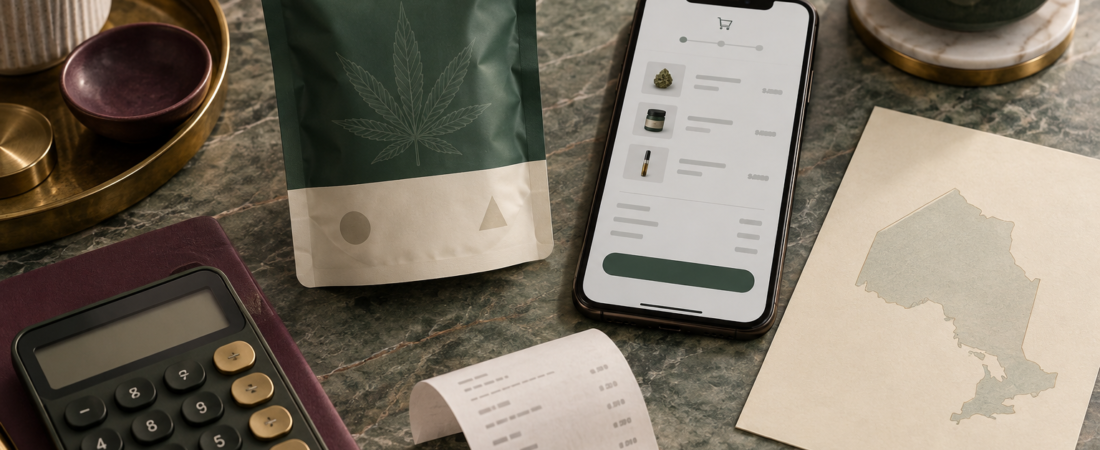
A low menu price does not always lead to a low cannabis delivery total. Minimum-order thresholds, delivery zones, taxes, promotions, substitutions, and the temptation to add one more item can turn a simple purchase into a larger cart than you planned.
The useful comparison is not “Which store has the cheapest flower?” It is “What will this legal order cost at the door, and am I buying only what I intended to use?” This guide gives Ontario adults a practical way to compare cannabis delivery fees and checkout terms in 2026 without treating speed, freebies, or high THC as value.
- Verify the exact retailer or fulfilment store through an official Ontario source.
- Write down the product subtotal before adding anything for a promotion.
- Add delivery, service, tax, and payment charges shown at checkout.
- Check the minimum order and whether it changes by delivery zone.
- Confirm the delivery window, ID requirement, substitution policy, and final total.
Verify the seller before comparing fees
A clear fee table does not prove that a seller is authorized. Ontario adults should begin with an official source, then compare the commercial terms of the exact store they verified. The Government of Ontario’s page on buying recreational cannabis explains the province’s legal retail framework and age requirement. The OCS store locator and AGCO store information can help you match a location before you pay.
Check the business name, physical address, and website details rather than relying on a similar brand name in search results. Our guide to verifying a legal cannabis store or delivery service provides a full pre-payment routine. Complete that step first; a cheap order from an unverified source is not a bargain.
Compare the landed total, not the first price you see
The landed total is the amount you expect to pay after every required charge. Start with the products you actually planned to buy. Then add taxes and any disclosed delivery, service, distance, or payment fees. If a tip is optional, keep it separate so you can compare retailer costs consistently.
Do not compare one store’s pre-tax menu tile with another store’s final checkout. Build the same realistic basket at each verified option and stop before payment. A $30 item with a $15 delivery charge costs more than a $36 item with a $5 charge, even though the first product looked cheaper.
| Checkout signal | What to record | Common trap |
|---|---|---|
| Product subtotal | Only the items you planned to buy | Adding an unnecessary item to unlock a deal |
| Delivery charge | Fee for your exact postal code or zone | Assuming a headline “free” offer applies everywhere |
| Minimum order | Required subtotal before checkout | Treating the threshold as a spending target |
| Promotion | Eligibility, exclusions, and expiry | Counting a freebie you did not want as savings |
| Final total | All mandatory charges before payment | Comparing against another store’s incomplete price |
Do not spend up to “free delivery” automatically
A free-delivery threshold can be useful when your planned order already qualifies. It is not useful when you spend $25 more to avoid a $10 fee. In that case, the cart grew by $15 even after the fee disappeared.
Use a simple rule: compare the final total of your original basket with the final total after qualifying. If the qualifying cart costs more, ask whether the extra product was already on your list and can be stored safely. If not, pay the smaller fee, choose pickup, or use a different verified retailer.
The same logic applies to bundles, reward points, gifts, and “buy more” promotions. A bonus product has no budget value if you did not want it, do not understand its potency, or cannot store it securely. The WeedMarkers cannabis shopping budget guide shows how to compare package size and usable value without overbuying.
Read delivery zones as carefully as product pages
Delivery terms often depend on the address. A retailer may use one rule inside a core service area and a different minimum or fee outside it. Enter the real postal code before assuming that a homepage promise applies to your order.
Posted terms can still change, so use them as a starting point and confirm the checkout. For example, this local delivery site publishes different minimum and fee language for its core city and surrounding area. That makes it a relevant example of why shoppers should record zone-specific terms rather than relying on a general headline. As with any delivery option, independently verify the seller and exact fulfilment location through official Ontario sources before ordering.
Also confirm whether the address is eligible at all. Condos, apartments, hotels, campuses, offices, and rural properties can create access or handoff complications. If you live in a multi-unit building, our guide to cannabis delivery for apartments and condos covers buzzers, lobbies, building rules, and secure handoffs.
Put delivery time into the value calculation
A cheap order is not good value if its delivery window makes you miss the handoff. Check the order cutoff, estimated window, how updates are sent, and what happens when the recipient cannot be reached. Legal cannabis delivery involves age controls; plan for an eligible adult to receive the package rather than asking for it to be left unattended.
The Government of Ontario states that the minimum age to buy, use, possess, and grow recreational cannabis is 19. Its cannabis laws overview also summarizes Ontario possession and consumption rules. Have valid identification available when required and do not schedule a handoff you cannot attend.
If pickup is faster or easier, include transportation, parking, and your time in the comparison. The WeedMarkers guide to delivery versus dispensary pickup helps match the buying method to your schedule and need for product advice.
Check substitutions before you authorize payment
Inventory can change between browsing and fulfilment. Read what the retailer says about out-of-stock items, substitutions, cancellations, and refunds. A substitute should not quietly change the format, package size, potency, or price you agreed to.
If the policy is unclear, choose “no substitutions” when available or contact the verified store before paying. Keep a screenshot or note of the cart, final total, stated delivery terms, and order confirmation. When the package arrives, compare the product name, quantity, and regulated label with the receipt before opening it.
Health Canada’s guide to reading and understanding cannabis product labels explains where to find THC, CBD, product, and packaging information. A replacement that is “similar” by category may still be materially different in strength or serving size.
A practical three-cart comparison
When you have more than one verified option, create three notes rather than three large carts:
- Original basket: the product and quantity you intended to buy.
- Delivered basket: the original basket plus every mandatory delivery and service charge.
- Threshold basket: the items required to reach a free-delivery or promotion threshold.
Choose the lowest sensible landed total, not automatically the lowest fee. If pickup is feasible, add it as a fourth option. Keep product format and quantity similar across stores so you are measuring delivery economics rather than comparing unrelated products.
- the exact store cannot be matched to an official listing;
- the total changes without a clear itemized reason;
- a minimum appears only after you have built the cart;
- the site pressures you to add stronger or unfamiliar products;
- delivery terms for your address remain unclear; or
- the seller wants to move payment into a personal transfer or direct message.
Bottom line
Compare cannabis delivery by the legal seller, the original basket, and the final amount due—not by the loudest promotion. Verify the exact retailer first, enter the real delivery address, record every mandatory fee, and treat minimums as conditions rather than goals.
The best checkout is usually the boring one: the product you intended to buy, a total you understood in advance, a delivery window you can receive, and a sealed regulated package that matches the receipt.